
Why Percentages and Metrics Can Hurt Your Aerospace Resume
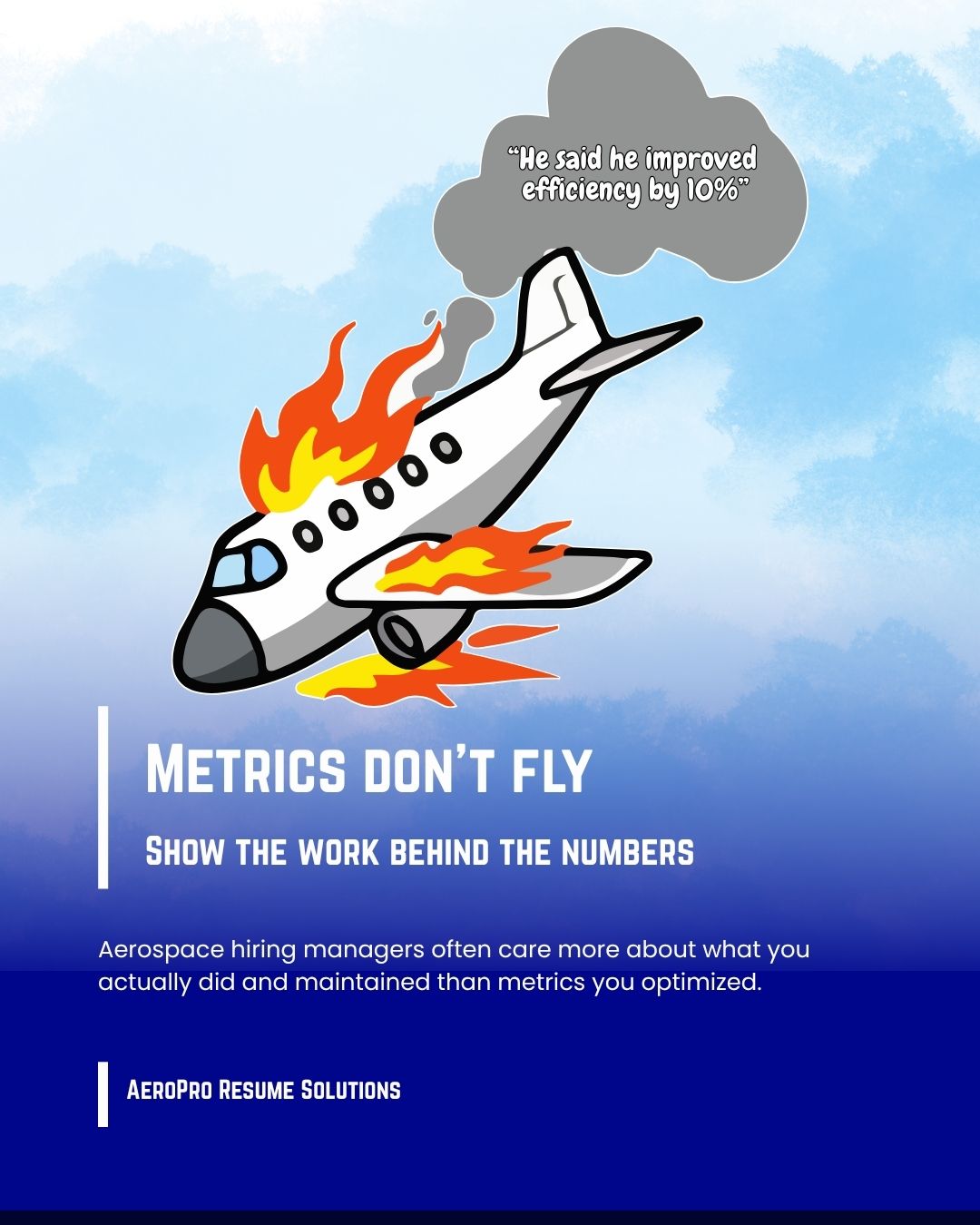
Metrics don’t fly
Somewhere along the way, resume advice turned into one big math problem. Quantify everything. Slap a percentage on it. Turn every task you’ve ever done into a number that supposedly proves your worth. “Improved efficiency by 10%.” “Reduced turnaround time by 15%.” It looks sharp on a slide deck. On an aerospace maintenance resume, it does almost nothing.
When a recruiter or a maintenance manager opens your resume for a mechanic role, they aren’t looking for a story about optimization. They’re looking for a match. Can this person work the aircraft we operate? Are they signed off on the systems we need? Have they done the checks, the inspections, the troubleshooting we’re hiring for? That’s the screen. Everything else is noise.
Why the percentages fall flat
A number without context is a claim nobody can verify. “Improved efficiency by 10%” – efficiency of what? Measured how? Against what baseline? Confirmed by whom? The person reading your resume knows they can’t check it, and they know you know that too. So instead of building trust, the metric quietly does the opposite. It reads like something a career coach told you to write, not something that came out of a hangar.
That matters more than most applicants realize. Aerospace maintenance hiring runs on credibility. The people screening resumes have done the work or manage the people who do. They can spot padding from across the room. A resume stuffed with optimization language signals that you learned to write a resume from a generic template built for desk jobs.
The accomplishment-driven, results-obsessed advice you see everywhere was built for sales reps, marketers, and project managers. Those are jobs where the output is a number. Yours isn’t. Your job is keeping aircraft airworthy and returning them to service correctly. The value lives in the work itself, and the work is exactly what you leave off the page when you chase metrics.
What hiring managers actually read for
Show the work. Name the aircraft — the specific types and variants, not “various aircraft.” Name the systems you’re qualified on. Spell out the checks and inspections you perform, the tasks you’re signed off to complete, the certifications and ratings you hold. Describe the scope: line or hangar, heavy checks or quick turnarounds, the environments you’ve worked in.
That’s the information the person making the decision needs to move you forward. A manager reading “performed scheduled and unscheduled maintenance on 737NG including landing gear replacement, troubleshooting, and return-to-service” knows exactly what you can do the moment they hire you. A line claiming you “boosted throughput by 12%” gives them nothing to act on.
When you lead with the actual work, you’re speaking the reader’s language. You’re handing them a straight line to “yes, this person can do the job.” When you lead with metrics, you’re asking them to translate marketing back into capability, and busy screeners don’t translate. They move on to the next resume.
None of this means numbers are banned. Maintenance hours, fleet size, the number of aircraft you supported – those are facts that describe scope, and scope is useful. The problem is inventing performance percentages that were never really tracked, because someone told you resumes need them. They don’t. Not in this industry.
Your experience is the strongest thing on the page. Stop dressing it up as a business case and let it stand as what it is: proof you can do the work.
Book a consultation on our Services page.